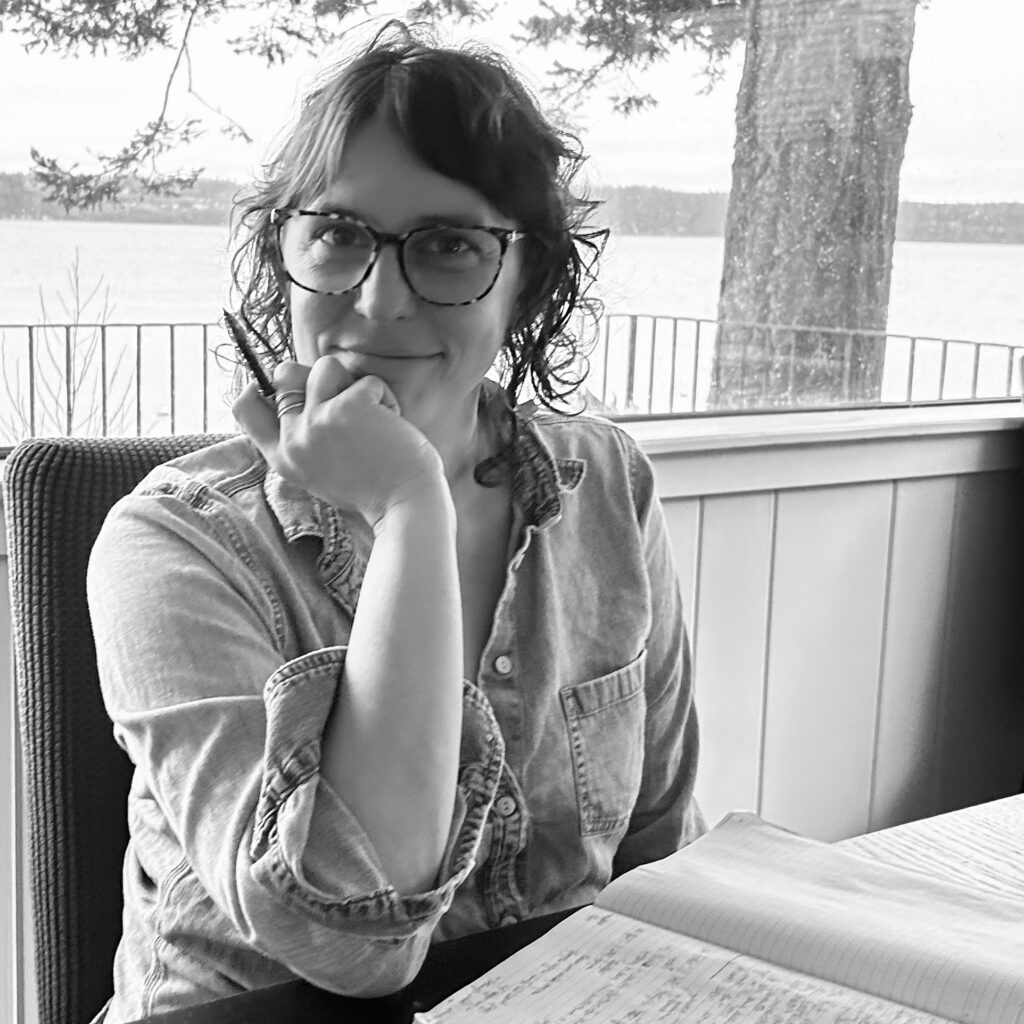
Jessica, one of our 2025 Crow fellows, is a full professor and the Writing Center Faculty Lead at Cascadia College, a liberal arts community college co-located with the University of Washington Bothell (UW Bothell) campus. Jessica first learned about Crow from one of her colleagues at UW Bothell years ago and then became reintroduced to the project through her Cascadia colleagues who also served as Crow Fellows. Since then, she has only become more interested in corpora-based learning. She believes “Crow and corpora-based learning in general is something that is so powerful because it is a stronger and more analog alternative to what some students are trying to get from their large language model AI usage…I want students and faculty to understand what large language models look like, and how useful those are for our purposes.”
In February and March of 2025, Jessica participated in two Crow workshops with other Cascadia faculty. On May 9th, 2025, Jessica then co-hosted our hybrid Crow Tutor Workshop with Shelley Staples and Randi Reppen as a follow up workshop to these two other Crow workshops. This workshop was designed to train tutors at the writing center that Jessica directs at Cascadia. At this workshop, tutors:
- Learned how to access and use our corpus and repository.
- Learned more about the functions of a repository.
- Looked at the beginning of student essays from the corpus to discover writing patterns in a short 20-minute session.
- Experimented with input fields in the repository to understand verb usage.
- Participated in roleplay involving two attendees.
The roleplay paired two attendees: one as the tutor and the other as the student. During roleplay, the “student” tried to understand what a specific genre is based on looking at several essays from that same genre. The “tutor” practiced asking questions to guide the student toward an answer, while the student used our corpus and repository and asked questions related to navigating and using the interface. The goal of roleplay was to get practice for real interactions between tutors and students, focusing on strengthening communication skills and fostering discovery. This workshop helped tutors understand how to navigate and use our corpus and repository, while giving Jessica the ability to share what she learned with others.
More specifically, since attending this workshop, Jessica says, “My primary use of Crow has been with writing tutors, as opposed to in my own classes. So I’ve been training tutors to use Crow; to support their work with faculty and with students.” As the writing center faculty lead, she shares that “this particular role isn’t administrative, it really is hands-on working with tutors.” Jessica works with tutors to help them understand writing center research and pedagogy, and she says, “At the end of the day, I’m trying to help make sure that our tutors feel as confident and prepared as possible to work with students individually and then also to lead embedded class workshops.” All first-year composition classes at Cascadia have an embedded peer tutor, so this training has been beneficial.
Jessica teaches her tutors how to use Crow’s corpus and repository to discover patterns in writing, understand writing pedagogy, explore genre conventions, and to gain a deeper understanding of the elements and dynamics of writing. This includes understanding the importance of the revision process in writing and exploring the elements that make writing effective. Working with Crow helps her tutors be more effective because they can share what they learned with other faculty members and students to help them make their writing more successful. This is also beneficial because she says, “it’s another way to get faculty to understand what Crow is, too.” Finally, since there is limited resources and time to meet with these tutors, learning from Crow has been highly beneficial for Jessica. “Crow has helped me a lot,” she explained, “We don’t have the resources to have our own internal repository of student work and student writing.”
Jessica has also used Crow for co-designing sessions and revision analysis workshops. In one of her co-designing sessions, tutors and students looked at rhetorical analysis papers from the Crow corpus to discover what the different paragraphs in these papers are truly trying to express. They looked at verb usage, elements that came across as strong, interesting, or persuasive, and they explored the structure of these papers to then attempt writing a rhetorical analysis on their own. Jessica describes the process as a “Frankenstein situation” because tutors and students are breaking down these papers to explore the differences in language, structure, and intent across these different pieces of writing.
In one of her revision analysis workshops, Jessica worked with tutors and they pulled five different pieces of student writing from our corpus that had at least three revisions made to them. They looked at these 15 different revised documents, exploring their revisions, to discover what they would call these revisions and to find new approaches to revision that they could use themselves. Essentially, tutors explored how revision looked different across various student papers, asking questions like, “When are students revising their ideas and when are they revising their words? When are students revising their organization?” Jessica has also used Crow for other workshops. One workshop explored language and persuasive elements in writing, another discussed summary versus evaluation writing, and another discussed appropriate genres for topics which meant exploring questions like, “What audience would read this? Based on the audience, what genre should this topic be placed in?”
In the next few years, Jessica will continue to use what she has learned from Crow to help others become better writers. In general, she wants to continue conducting research on adapting human centered design practices for student writing contexts. Specifically, she wants to focus on strengthening writers’ revision capabilities. Jessica shared that many students at Cascadia College can be resistant to revising because this can be a hard and tedious process, especially for students who aim for perfection or find it hard to change or cut down their writing after a first draft has been completed. Therefore, she plans to host more workshops for her tutors. Her first workshop for the next quarter will be focused on the revision process. She plans to review Crow and Crow materials with her tutors and then discuss different revision lenses, exploring the revision process by looking at and comparing different student papers with revisions from our platform.
We are excited to see more great things from Jessica in the years to come!